Usage Examples
This page contains executable examples that run during the documentation build. Every code block below is a live @example — the output you see is produced by the actual RxGP code.
GP Regression with Function Observations
A minimal sparse GP regression using UniSGP nodes.
1. Generate synthetic data
using RxInfer, RxGP
using BayesBase
using KernelFunctions, LinearAlgebra, Random, Plots, StableRNGs

rng = StableRNG(42)
N  = 30
Nu = 20

# Training data: noisy sinc
xtrain = sort(rand(rng, N) .* 8 .- 4)
ytrain = sinc.(xtrain) .+ 0.05 .* randn(rng, N)

# Inducing inputs: evenly spaced
Xu = [[x] for x in range(-4, 4; length=Nu)]

# Test grid for prediction
xtest = [[x] for x in range(-6, 6; length=200)]

scatter(xtrain, ytrain, label="Observations", xlabel="x", ylabel="y", legend=:topright)
plot!(range(-6, 6; length=200), sinc.(range(-6, 6; length=200)),
      label="True sinc(x)", lw=2, color=:green)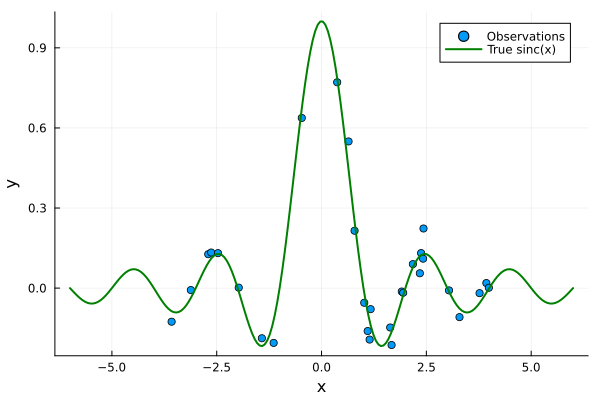
2. Configure the kernel
D = 1
mean_fn = (x) -> 0.0
kernel, θ_init, dim_θ = get_simple_kernel_and_params(D; kernel_spec=:SE)
get_simple_kernel_and_params returns a parameterised squared-exponential kernel.
3. Define the model
@model function gp_regression(y, x, Xu, θ, mv_prior, gamma_prior)
    v ~ mv_prior
    w ~ gamma_prior
    for i in eachindex(y)
        y[i] ~ UniSGP(x[i], v, w, θ)
    end
end

@meta function gpr_meta(; Xu, θ)
    UniSGP() -> get_UniSGPMeta(D;
        mean_fn  = mean_fn,
        kernel   = kernel,
        operator = :fn,
        Xu       = Xu,
        θ        = θ,
    )
end

@initialization function gpr_init(q_v_init, q_w_init)
    q(v) = q_v_init
    q(w) = q_w_init
end

gpr_constraints = @constraints begin
    q(v, w) = q(v)q(w)
end
Each UniSGP factor connects an input x[i] and observation y[i] to the shared inducing variables v, noise precision w, and hyperparameters θ. The @meta block tells RxInfer which meta object to attach to each node type.
4. Run inference with hyperparameter optimisation
We alternate between VMP inference (E-step) and gradient-based hyperparameter updates (M-step):
using Flux, ForwardDiff

optimizer = Flux.AdaMax(0.01)
state = Flux.setup(optimizer, θ_init)
θ_opt = deepcopy(θ_init)
grad  = similar(θ_opt)

q_v = MvNormalWeightedMeanPrecision(zeros(Nu), 50 * diageye(Nu))
q_w = GammaShapeRate(1e-2, 1e-2)

FE_history = Float64[]
θ_history  = Vector{Float64}[]   # track hyperparameters

for run in 1:15
    global q_v, q_w
    # E-step: run VMP inference (feed previous posterior as prior)
    res = infer(
        model          = gp_regression(Xu=Xu, θ=θ_opt, mv_prior=q_v, gamma_prior=q_w),
        data           = (y=ytrain, x=[[x] for x in xtrain]),
        meta           = gpr_meta(Xu=Xu, θ=θ_opt),
        initialization = gpr_init(q_v, q_w),
        constraints    = gpr_constraints,
        returnvars     = KeepLast(),
        iterations     = 2,
        free_energy    = true,
    )
    q_v = res.posteriors[:v]
    q_w = res.posteriors[:w]
    push!(FE_history, res.free_energy[end])
    push!(θ_history, copy(θ_opt))

    # M-step: optimise kernel hyperparameters
    for epoch in 1:10
        grad_llh_default!(grad, θ_opt;
            y_data    = ytrain,
            x_y_data  = [[x] for x in xtrain],
            x_ω_data  = [[x] for x in xtrain],
            q_v       = q_v,
            q_w       = q_w,
            kernel    = kernel,
            mean_fn   = mean_fn,
            Xu        = Xu,
        )
        Flux.Optimise.update!(state, θ_opt, grad)
    end
end

using StatsFuns
θ_mat = reduce(hcat, θ_history)'  # runs × params

p1 = plot(FE_history, xlabel="Run", ylabel="Free Energy", label="FE", lw=2, left_margin=8Plots.mm, bottom_margin=6Plots.mm)
p2 = plot(xlabel="Run", ylabel="softplus(θ)", title="Hyperparameters", left_margin=8Plots.mm, bottom_margin=6Plots.mm)
for j in 1:size(θ_mat, 2)
    plot!(p2, StatsFuns.softplus.(θ_mat[:, j]), label="θ$j", lw=2)
end
plot(p1, p2, layout=(1,2), size=(900, 320))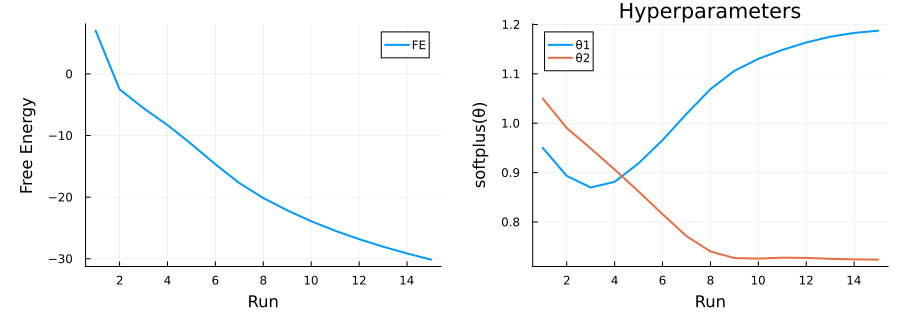
5. Predict on the test grid
meta_fn = get_UniSGPMeta(D;
    mean_fn=mean_fn, kernel=kernel,
    operator=:fn, Xu=Xu, θ=θ_opt)

means, covs = predict_GP(
    m_in = xtest,
    q_v  = q_v,
    q_θ  = θ_opt,
    meta = meta_fn,
)

pred_μ = [m[1] for m in means]
pred_σ = [sqrt(C[1,1]) for C in covs]

plot(range(-6, 6; length=200), pred_μ, ribbon=pred_σ, fillalpha=0.2,
     label="Prediction ± 1σ", lw=2, color=:blue, xlabel="x", ylabel="y",
     legend=:topright)
plot!(range(-6, 6; length=200), sinc.(range(-6, 6; length=200)),
      label="True sinc(x)", lw=2, color=:green)
scatter!(xtrain, ytrain, label="Observations", ms=3, color=:black)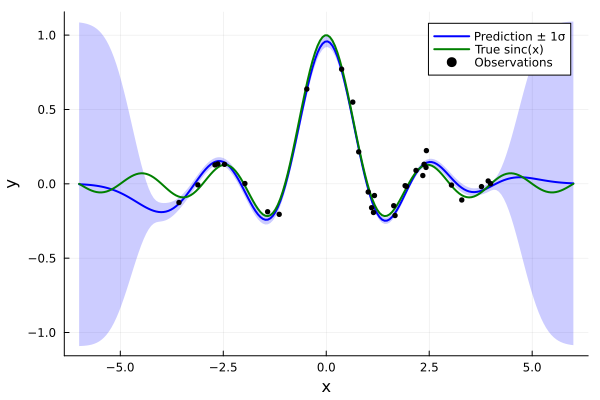
Adding Gradient Observations
The UniSGP_dID node extends the model to observe gradients of the latent GP. We add gradient measurements using operator = :grad and a Wishart noise prior.
1. Generate gradient data
# cosc(x) = d/dx sinc(x) = (cos(πx) - sinc(x)) / x
cosc(x) = x == 0 ? zero(x) : (cos(π*x) - sinc(x)) / x
ωtrain = cosc.(xtrain) .+ 0.05 .* randn(rng, N)

xs_plot = range(-6, 6; length=200)
plot(xs_plot, sinc.(xs_plot), label="True sinc(x)", lw=2, color=:green,
     xlabel="x", ylabel="y", legend=:topright)
plot!(xs_plot, cosc.(xs_plot), label="True cosc(x)", lw=2, color=:magenta)
scatter!(xtrain, ytrain, label="Value obs")
scatter!(xtrain, ωtrain, label="Gradient obs", marker=:cross)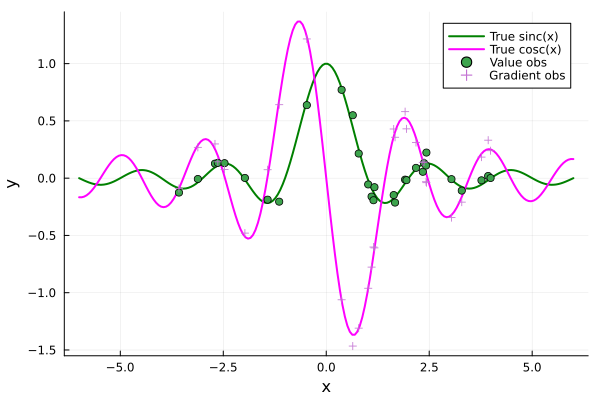
2. Build a joint model
meta_grad = get_UniSGPMeta(D;
    mean_fn  = mean_fn,
    kernel   = kernel,
    operator = :grad,
    Xu       = Xu,
    θ        = θ_init,
)

@model function gp_regression_with_grads(y, ω, x, Xu, θ, qv_params, qw_params, qWg_params)
    v  ~ MvNormalWeightedMeanPrecision(qv_params...)
    w  ~ GammaShapeRate(qw_params...)
    Wg ~ Wishart(qWg_params...)
    for i in eachindex(y)
        y[i] ~ UniSGP(x[i], v, w, θ)
        ω[i] ~ UniSGP_dID(x[i], v, Wg, θ)
    end
end
The UniSGP and UniSGP_dID nodes share the same inducing variables v and hyperparameters θ, allowing the function-value and gradient observations to jointly inform the GP.
3. Infer and predict with joint operator
gp_constraints_joint = @constraints begin
    q(v, w, Wg) = q(v)q(w)q(Wg)
end

@meta function joint_meta(; Xu, θ)
    UniSGP()     -> get_UniSGPMeta(D;
        mean_fn=mean_fn, kernel=kernel,
        operator=:fn, Xu=Xu, θ=θ)
    UniSGP_dID() -> get_UniSGPMeta(D;
        mean_fn=mean_fn, kernel=kernel,
        operator=:grad, Xu=Xu, θ=θ)
end

@initialization function joint_init(qv_params, qw_params, qWg_params)
    q(v)  = MvNormalWeightedMeanPrecision(qv_params...)
    q(w)  = GammaShapeRate(qw_params...)
    q(Wg) = Wishart(qWg_params...)
end

# Build operator functions for the gradient hyperparameter objective
meta_grad_obj = get_UniSGPMeta(D; mean_fn=mean_fn, kernel=kernel, operator=:grad, Xu=Xu, θ=θ_opt)
Lm_fn  = getLm_fn(meta_grad_obj)
Kxx_fn = getKxx_fn(meta_grad_obj)
Kxu_fn = getKxu_fn(meta_grad_obj)

θ_joint = deepcopy(θ_opt)
state_j = Flux.setup(Flux.AdaMax(0.01), θ_joint)
grad_j  = similar(θ_joint)

q_v_j  = MvNormalWeightedMeanPrecision(zeros(Nu), 50 * diageye(Nu))
q_w_j  = GammaShapeRate(1e-2, 1e-2)
q_Wg_j = Wishart(1, Matrix(1.0I, 1, 1))

FE_joint = Float64[]
θ_joint_history = Vector{Float64}[]

for run in 1:15
    global q_v_j, q_w_j, q_Wg_j
    # Feed previous posteriors as priors
    res_j = infer(
        model          = gp_regression_with_grads(
            Xu=Xu,
            θ=θ_joint,
            qv_params=BayesBase.params(q_v_j),
            qw_params=BayesBase.params(q_w_j),
            qWg_params=BayesBase.params(q_Wg_j),
        ),
        data           = (y=ytrain, ω=[[ω] for ω in ωtrain], x=[[x] for x in xtrain]),
        meta           = joint_meta(Xu=Xu, θ=θ_joint),
        initialization = joint_init(
            BayesBase.params(q_v_j),
            BayesBase.params(q_w_j),
            BayesBase.params(q_Wg_j),
        ),
        constraints    = gp_constraints_joint,
        returnvars     = KeepLast(),
        iterations     = 2,
        free_energy    = true,
    )
    q_v_j  = res_j.posteriors[:v]
    q_w_j  = res_j.posteriors[:w]
    q_Wg_j = res_j.posteriors[:Wg]
    push!(FE_joint, res_j.free_energy[end])
    push!(θ_joint_history, copy(θ_joint))

    for epoch in 1:10
        grad_llh_default!(grad_j, θ_joint;
            y_data   = ytrain,
            ω_data   = [[ω] for ω in ωtrain],
            x_y_data = [[x] for x in xtrain],
            x_ω_data = [[x] for x in xtrain],
            q_v      = q_v_j,
            q_w      = q_w_j,
            q_Wg     = q_Wg_j,
            kernel   = kernel,
            Lm_fn    = Lm_fn,
            Kxx_fn   = Kxx_fn,
            Kxu_fn   = Kxu_fn,
            mean_fn  = mean_fn,
            Xu       = Xu,
        )
        Flux.Optimise.update!(state_j, θ_joint, grad_j)
    end
end

θj_mat = reduce(hcat, θ_joint_history)'
pj1 = plot(FE_joint, xlabel="Run", ylabel="Free Energy", label="FE", lw=2, left_margin=8Plots.mm, bottom_margin=6Plots.mm)
pj2 = plot(xlabel="Run", ylabel="softplus(θ)", title="Hyperparameters", left_margin=8Plots.mm, bottom_margin=6Plots.mm)
for j in 1:size(θj_mat, 2)
    plot!(pj2, StatsFuns.softplus.(θj_mat[:, j]), label="θ$j", lw=2)
end
plot(pj1, pj2, layout=(1,2), size=(900, 320))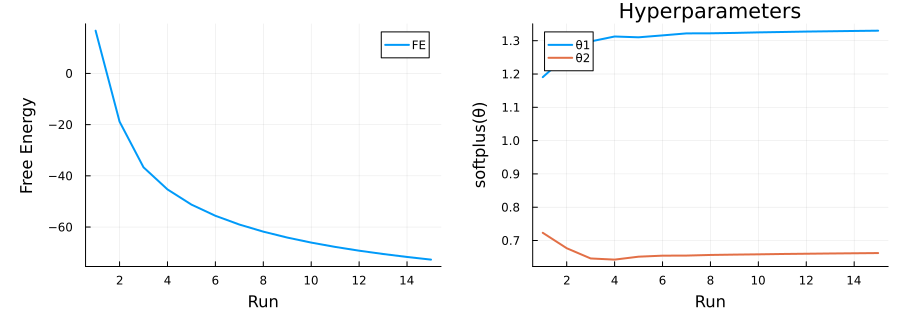
# Predict with the joint_fn_grad operator to get both function and gradient predictions
meta_joint = get_UniSGPMeta(D;
    mean_fn  = mean_fn,
    kernel   = kernel,
    operator = :joint_fn_grad,
    Xu       = Xu,
    θ        = θ_joint,
)
means_j, covs_j = predict_GP(
    m_in = xtest,
    q_v  = q_v_j,
    q_θ  = θ_joint,
    meta = meta_joint,
)

pred_f_μ = [m[1] for m in means_j]
pred_f_σ = [sqrt(C[1,1]) for C in covs_j]
pred_g_μ = [m[2] for m in means_j]
pred_g_σ = [sqrt(C[2,2]) for C in covs_j]

xs = range(-6, 6; length=200)

p = plot(layout=(1,2), size=(900, 350), legend=:topright)
plot!(p[1], xs, pred_f_μ, ribbon=pred_f_σ, fillalpha=0.2,
      label="f(x) pred", lw=2, color=:blue, xlabel="x", ylabel="f(x)")
plot!(p[1], xs, sinc.(xs), label="True sinc", lw=2, color=:green)
scatter!(p[1], xtrain, ytrain, label="Value obs", ms=3, color=:black)

plot!(p[2], xs, pred_g_μ, ribbon=pred_g_σ, fillalpha=0.2,
      label="∇f(x) pred", lw=2, color=:red, xlabel="x", ylabel="∇f(x)")
plot!(p[2], xs, cosc.(xs), label="True cosc", lw=2, color=:magenta)
scatter!(p[2], xtrain, ωtrain, label="Grad obs", ms=3, marker=:cross, color=:black)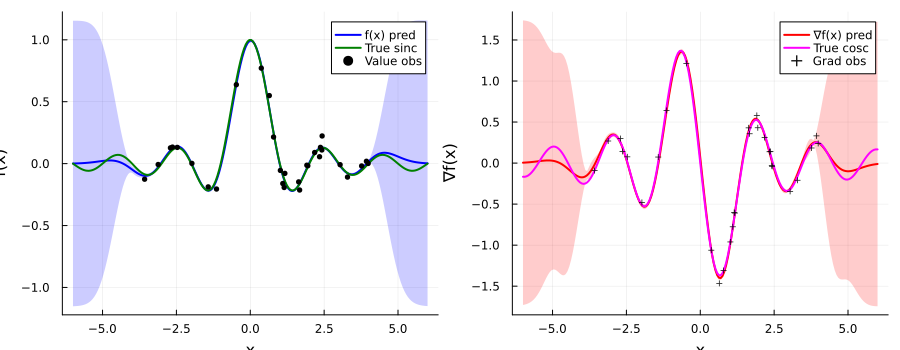
The left panel shows the function prediction and the right panel shows the gradient prediction. Both benefit from the shared inducing variables.